
Insight

AQIL Digital
AQIL Digital Editorial
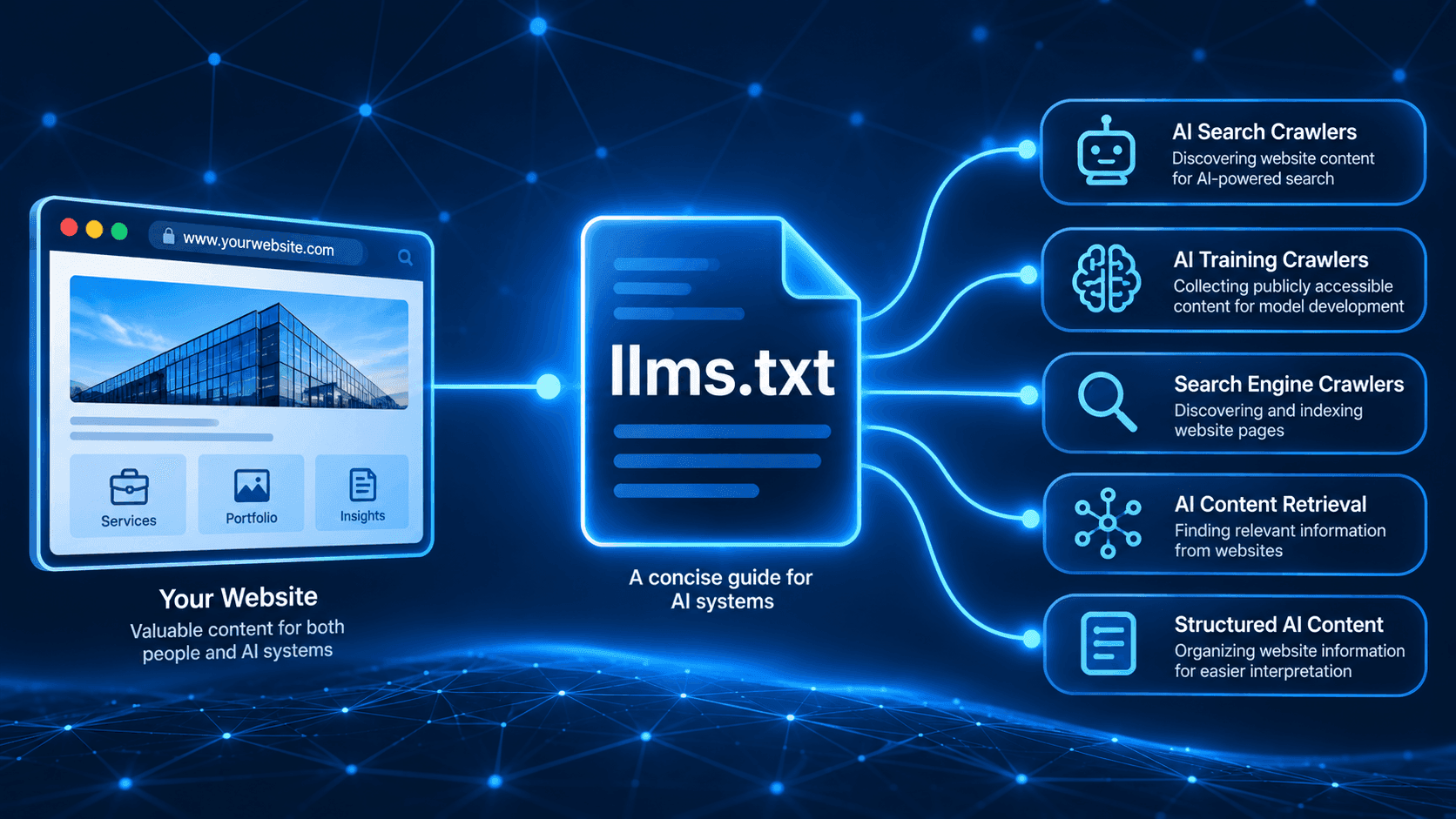
As AI-powered assistants change how people discover businesses, website owners are exploring ways to make their content easier for artificial intelligence systems to access and understand. Discover how llms.txt, llms-full.txt, AI crawlers and emerging AI.txt proposals fit into the evolving landscape of AI-driven website discovery.
Audio summary
Listen to this article
Search engines are no longer the only way people find information online. AI-powered assistants and conversational search tools are changing how users research products, compare services and discover businesses.
For businesses, this creates a new consideration: is their website structured in a way that allows AI systems to access, interpret and accurately understand its information?
Traditional SEO remains important, but website owners are increasingly exploring additional approaches to content accessibility and machine readability. Among these are llms.txt, llms-full.txt and emerging AI usage policy files.
Understanding what these files do, what they do not do, and how they fit into a broader digital strategy can help businesses make more informed technical decisions.
AI crawlers are automated systems that access publicly available website content for different purposes.
Depending on the provider, these systems may collect information for search indexing, AI training, content retrieval or real-time browsing.
Some examples of publicly documented crawlers include:
OAI-SearchBot: Used by OpenAI for search-related discovery.GPTBot: OpenAI’s crawler associated with potential model training.ClaudeBot: Anthropic’s web crawler.Googlebot: Google’s search crawler, which supports Google’s search ecosystem.These crawlers do not necessarily have the same purpose or access requirements.
A website can allow one crawler while restricting another. This makes understanding crawler policies and maintaining an accessible website important.
The llms.txt proposal introduces a Markdown-based file that websites can publish at their root directory.
Its purpose is to provide AI systems with a concise introduction to a website and a curated directory of its most useful content.
Rather than requiring an AI agent to interpret an entire website immediately, the file offers a structured starting point.
A typical llms.txt can include:
For example:
https://www.example.com/llms.txt
The format was proposed to make website information easier for language models and other automated agents to navigate.
However, llms.txt is a community proposal, not a universally adopted web standard. Publishing it does not guarantee that search engines or AI assistants will read it, cite the website or improve its visibility.
While llms.txt is intended to provide a concise overview and directory, llms-full.txt is commonly used as a more comprehensive companion document.
It can consolidate important website information into a single plain-text resource.
For example, a business might include:
This gives an AI agent or retrieval system another way to consume the business’s published information without navigating multiple individual pages.
Unlike the original llms.txt proposal, llms-full.txt is an informal convention rather than a formally defined part of that proposal.
At AQIL Digital, we use both files as part of our approach to machine-readable website content.
Our llms.txt provides an index of important business information and resources, while our dynamically generated llms-full.txt consolidates information about our services, portfolio, FAQs and Insights.
The content is generated using our website’s content management system, helping keep the information aligned with published website content.
These files are intended to make our information easier for compatible AI tools and agents to consume. They are not a guarantee of AI search rankings or citations.
Although these files are sometimes discussed together, they serve different purposes.
robots.txt — Communicates crawler access rulessitemap.xml — Helps search engines discover website URLsllms.txt — Provides an AI-oriented website overview and content indexllms-full.txt — Provides a consolidated text reference of website contentAI.txt — An emerging concept for communicating AI usage preferences and policiesIt is important not to treat these files as interchangeable.
For example, llms.txt does not grant permission to crawl restricted pages, and it does not override the rules established through robots.txt.
Similarly, a sitemap does not explain the meaning or business context of every page it lists.
A well-maintained website should have a clear purpose for each file.
Another concept receiving attention is AI.txt.
The term is used in different proposals, so it is important to distinguish between them.
One emerging Internet-Draft proposes an AI usage declaration file at:
/.well-known/ai.txt
The idea is to give website owners a structured way to communicate preferences concerning:
This is different from llms.txt.
While llms.txt focuses on helping AI systems understand a website, the proposed AI.txt approach focuses on communicating how website content may be used.
Potentially, yes.
A clearly written AI usage policy can help communicate an organisation’s preferences regarding content usage, licensing and attribution.
It may also provide a useful reference for AI developers and organisations that voluntarily choose to interpret the policy.
However, there are important limitations:
AI.txt standard.Businesses should therefore avoid treating AI.txt as a security mechanism, a legal guarantee or an AI SEO shortcut.
For most small and medium-sized businesses, a clearly maintained privacy policy, appropriate website terms, licensing statements and properly configured crawler rules remain more practical priorities.
An additional AI usage declaration can be considered when there is a specific content governance or licensing requirement.
This is one of the most important questions.
The existence of an AI-readable file does not automatically mean an AI platform will use it.
There is currently no established evidence that publishing llms.txt or llms-full.txt directly improves rankings in Google Search or guarantees that a business will appear in AI-generated answers.
Their potential value is primarily related to content accessibility and providing additional context to compatible tools.
Businesses should focus on the fundamentals first:
Explain services, products, business expertise and customer benefits in straightforward language.
Use relevant Schema.org structured data to help search engines understand business information and page content.
Ensure important pages can be accessed by the appropriate crawlers and that the website responds reliably.
Publish useful, original information that demonstrates subject knowledge and answers genuine customer questions.
Keep company details, services, contact information and published pricing consistent across the website.
Consider llms.txt, llms-full.txt and clean Markdown content as additional resources where they provide practical value.
AI discoverability is not achieved by adding a collection of text files to a website. It comes from making the underlying business information accessible, useful, accurate and understandable.
A practical approach does not require rebuilding an existing website.
Businesses can begin with the following steps:
robots.txt and sitemap.llms.txt containing important pages and resources.llms-full.txt for more comprehensive business information.Files should be maintained alongside the website rather than treated as one-time SEO additions.
The evolution of AI-powered discovery presents businesses with another reason to invest in well-structured, accessible and informative websites.
Files such as llms.txt and llms-full.txt offer additional ways to organise website information for compatible AI tools and agents. Emerging proposals such as AI.txt also highlight the growing importance of content governance and responsible data usage.
However, none of these files replaces the fundamentals of a technically sound website, useful content, strong SEO foundations and a trustworthy digital presence.
At AQIL Digital, we believe the strongest digital foundations are built with both people and technology in mind.
Make your website understandable. Make your information accessible. Build a digital presence that is ready to evolve.
For a broader overview of how traditional SEO, AEO and GEO compare in an AI-driven search landscape, read our guide: Beyond SEO: How AI Is Changing the Way Businesses Get Discovered Online.
Further reading and primary sources:
Ready to build a more discoverable website?
We help businesses design and develop clear, structured, well-performing websites that work for both human visitors and the AI systems that surface them.
Start a projectNext insight
Search is evolving beyond traditional rankings. Discover how SEO, Answer Engine Optimisation (AEO), Generative Engine Optimisation (GEO), and AI-driven discovery are changing how businesses build visibility, establish authority, and reach potential customers.
Read next insight →
Learn why website traffic does not always translate into business opportunities, and discover practical ways to improve messaging, user journeys, trust, and calls to action.
A modern website should do more than look professional. Discover how clear messaging, thoughtful structure, and purposeful user experiences help businesses communicate their value and guide visitors toward meaningful action.
An underperforming website does not always need to be rebuilt. Learn how to identify whether targeted improvements or a more comprehensive redesign is the right approach for your business.